
E-mail:
Shangqi Guo, Ph.D., is an Assistant Professor at Tsinghua University. He received his bachelor's degree from the Mathematics and Physics Basic Science Program at the University of Electronic Science and Technology of China in 2015 and his Ph.D. degree from the Department of Automation at Tsinghua University in 2021. From 2021 to 2025, he conducted postdoctoral research in the Department of Precision Instrument at Tsinghua University. He has been an Assistant Professor at Tsinghua University since July 2025.
His research focuses on brain-inspired intelligence, brain-inspired world models, and interdisciplinary research at the intersection of brain-inspired intelligence and life sciences. His primary interests include abstraction and hierarchical representation, world modeling, continual adaptation, and autonomous decision-making in intelligent systems, as well as the application of brain-inspired intelligence to modeling complex biological systems.
He was selected for the National Postdoctoral Innovative Talents Support Program in 2022 and has received several honors, including the Tsinghua Shuimu Scholar, Outstanding Doctoral Graduate of Tsinghua University, and Outstanding Doctoral Dissertation Award of Tsinghua University. He has published numerous high-quality papers as first or corresponding author in leading international journals and conferences in artificial intelligence and robotics, including IEEE TPAMI, NeurIPS (Spotlight), ICML, AAAI, and CoRL. He has served as Principal Investigator of projects funded by the General Program and Young Scientists Fund (Category C) of the National Natural Science Foundation of China (NSFC), as well as the National Postdoctoral Innovative Talents Support Program.
His monograph, Brain-Inspired Intelligent Decision-Making: Abstraction, Hierarchy, and Neural Learning Mechanisms, received the 2026 Outstanding Academic Monograph Publication Grant from the China Postdoctoral Science Foundation. The book systematically investigates abstract representations, hierarchical organization, and neural learning mechanisms in brain-inspired decision intelligence. He has also participated as a key researcher in the Science and Technology Innovation 2030 Major Project on Brain Science and Brain-Inspired Research.
He regularly serves as a reviewer for leading international conferences and journals in artificial intelligence, machine learning, and robotics, including NeurIPS, ICML, ICLR, IJRR, and IEEE TCYB. He has also served as a Standing Committee Member of the Medical Engineering Interdisciplinary Committee of the Chinese Institute of Command and Control.
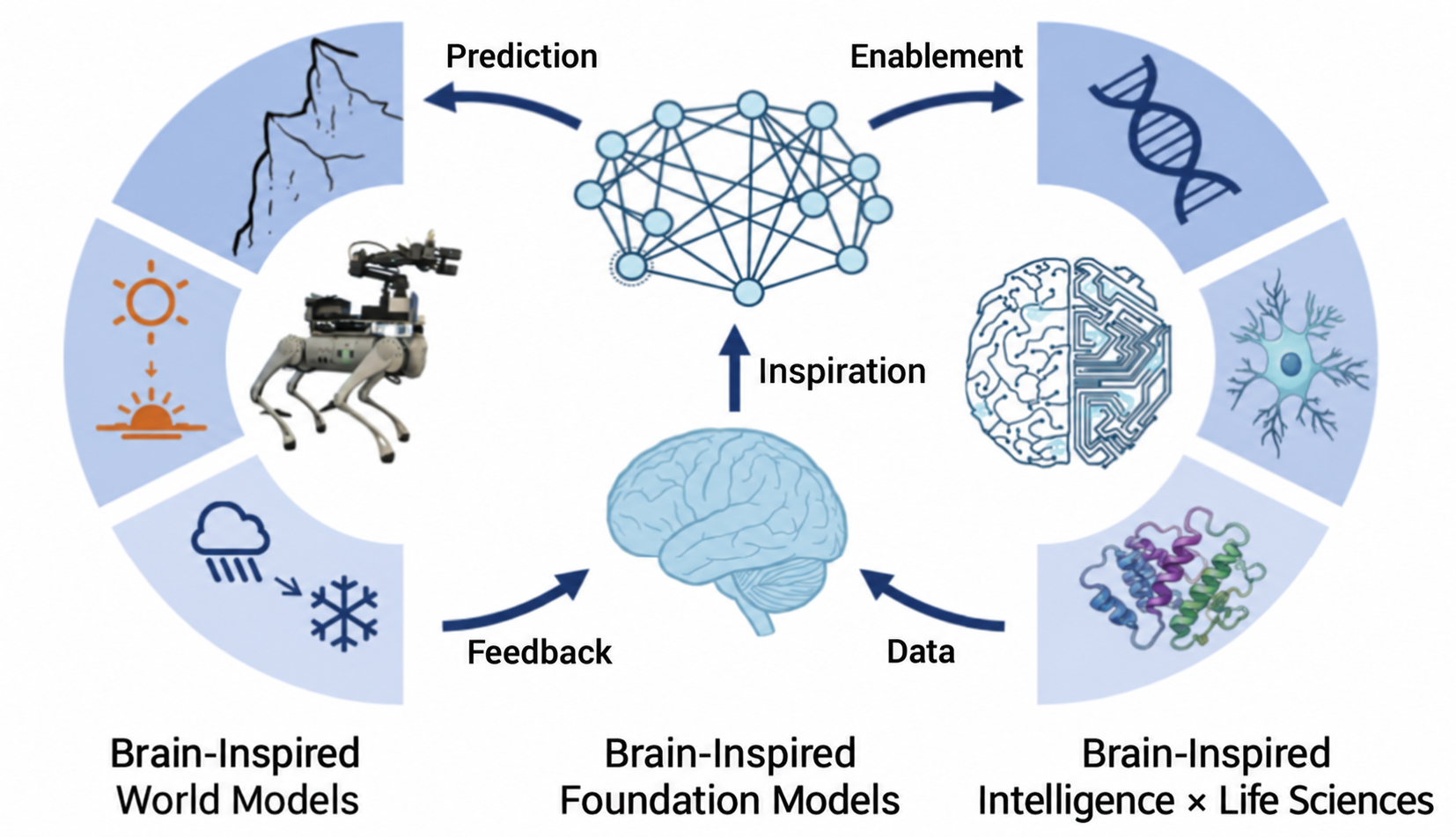
Our research addresses the emerging needs of next-generation artificial intelligence, focusing on brain-inspired large-scale models, brain-inspired world models, and interdisciplinary research at the intersection of brain-inspired intelligence and life sciences. We aim to develop brain-inspired foundation models, world models, and intelligent algorithms for robotics, while leveraging large models to advance life sciences research, including the analysis of genetic causes of disease, the investigation of fundamental biological mechanisms, and medical research on brain disorders.
(1) X. Li; Z. Zhou; K. Shen; W. Zhou; S. Guo*. Beyond Logits: Metastable Latent Dynamics for Sample-Efficient Best-of-N Selection in LLMs. Proceedings of the 43rd International Conference on Machine Learning (ICML), 2026.
(2) C. Gao; L. Li; Y. Zhou; S. Guo*. Complete-Tree Space Favors Data-Efficient Link Prediction. Proceedings of the 42nd International Conference on Machine Learning (ICML), Vancouver, Canada, 2025.
(3) Z. Yang; S. Guo*; Y. Fang; Z. Yu; J. K. Liu. Spiking Variational Policy Gradient for Brain Inspired Reinforcement Learning. IEEE Transactions on Pattern Analysis and Machine Intelligence, 2025, 47(3): 1975–1990.
(4) Y. Tang; S. Guo*; J. Liu; B. Wan; L. An; J. K. Liu. Hierarchical Reinforcement Learning from Imperfect Demonstrations through Reachable Coverage-Based Subgoal Filtering. Knowledge-Based Systems, 2024, 294(1).
(5) T. Zhang†; S. Guo†; T. Tan; X. Hu; F. Chen. Adjacency Constraint for Efficient Hierarchical Reinforcement Learning. IEEE Transactions on Pattern Analysis and Machine Intelligence, 2023, 45(4): 4152–4166.
(6) S. Guo; Q. Yan; X. Su; X. Hu; F. Chen. State-Temporal Compression in Reinforcement Learning with the Reward-Restricted Geodesic Metric. IEEE Transactions on Pattern Analysis and Machine Intelligence, 2022, 44(9): 5572–5589.
† Equal contribution (co-first authors); * Corresponding author.


 Home
 Teacher login