
 Home
Home Teacher login



Brain-Inspired Morphological Dendritic Network Computing Model
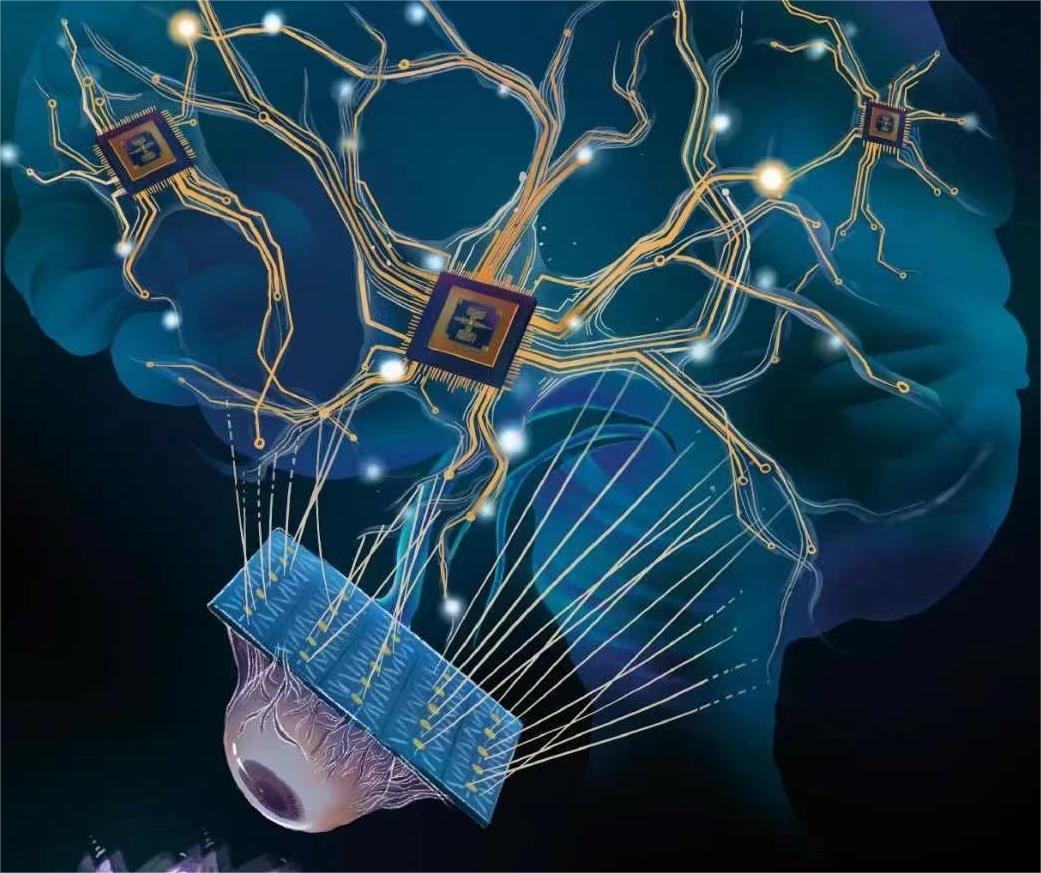
On June 6, 2024, our team published a brain-inspired neural computing model named "Dendristor" in Nature Electronics.
This innovative dendritic network emulates dendritic architectures and their inherent spatiotemporal processing characteristics, enabling high-efficiency visual perception for future artificial intelligence. Unlike the batch processing paradigm typical of existing artificial neural networks, the Dendristor processes information in a manner highly analogous to the biological morphology of neurons and their networks. The Dendristor model realizes specialized plasticity across dendritic branches and neurons, boosting learning efficiency within sparse neural networks. This architecture allows the Dendristor to encode the sequence and direction of incoming signals along its dendritic branches, strengthening its motion recognition capability. Notably, the model incorporates "silent synapses"—synapses activated by dendritic branch potentials—which heighten sensitivity to signal direction and streamline visual perception workflows. Leveraging this distinctive dendritic computing framework, our work unlocks new avenues for artificial intelligence, neuromorphic computing, and brain-inspired computing.
Neuromorphic dendritic network computation with silent synapses for visual motion perception
Eunhye Baek, Sen Song, Chang-Ki Baek, Zhao Rong, Luping Shi & Carlo Vittorio Cannistraci
Abstract:
Neuromorphic technologies typically employ a point neuron model, neglecting the spatiotemporal nature of neuronal computation. Dendritic morphology and synaptic organization are structurally tailored for spatiotemporal information processing, such as visual perception. Here we report a neuromorphic computational model that integrates synaptic organization with dendritic tree-like morphology. Based on the physics of multigate silicon nanowire transistors with ion-doped sol–gel films, our model—termed dendristor—performs dendritic computation at the device and neural-circuit level. The dendristor offers the bioplausible nonlinear integration of excitatory/inhibitory synaptic inputs and silent synapses with diverse spatial distribution dependency, emulating direction selectivity, which is the feature that reacts to signal direction on the dendrite. We also develop a neuromorphic dendritic neural circuit—a network of interconnected dendritic neurons—that serves as a building block for the design of a multilayer network system that emulates three-dimensional spatial motion perception in the retina.