
 Home
Home Teacher login



Published in Science Robotics: TianjicX, a Brain-Inspired Chip with Rich Spatiotemporal Elasticity for Enhanced Real-Time Multi-Task Processing in Edge Computing
The research was published in Science Robotics on June 15, 2022, and featured as a research highlight by AAAS News.
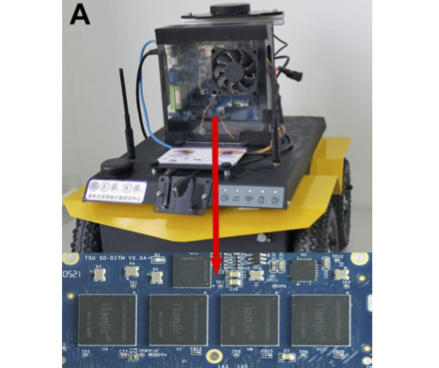
Led by Professor Shi Luping, Director of the Center for Brain-Inspired Computing, Department of Precision Instrument, Tsinghua University, the team developed a 28 nm neuromorphic chip named TianjicX. TianjicX achieves a peak dynamic energy efficiency of 3.2 TOPS/W, an on-chip memory bandwidth of 5.12 TB/s, and a computing density of 0.2 TOPS/mm². It supports adaptive allocation of computing resources and execution time scheduling for individual tasks. The research team built a multi-task mobile robot integrated with this chip, dubbed Tianjicat, which was programmed to play a cat-and-mouse game in the role of a cat. Experimental results demonstrate that compared with the NVIDIA Jetson TX2, running multiple neural networks on TianjicX cuts latency by approximately 98.74% and reduces dynamic power consumption by 50.66%. The authors conclude that TianjicX pioneers a new route for the development of computing hardware for mobile intelligent robots. It enables local execution of intensive, complex tasks with low latency and low power consumption, and supports parallel operation of multiple cross-paradigm neural network models on robots via various collaborative scheduling strategies.
Neuromorphic computing chip with spatiotemporal elasticity for multi-intelligent-tasking robots
Songchen Ma, Jing Pei, Wenhao Zhang, Dahu Feng, Fangwen Yu, Chenhang Song, Huanyu Qu, Cheng Ma, Mingsheng Lu, Faqiang Liu, Wenhao Zhou, Yujie Wu, Yihao lin, Hongyi Li, Taoyi Wang, Jiuru Song, Xue Liu, Guoqi Li, Rong Zhao, Luping Shi*
DOI: 10.1126/scirobotics.abk2948
Recent advances in artificial intelligence have enhanced the abilities of mobile robots in dealing with complex and dynamic scenarios. However, to enable computationally intensive algorithms to be executed locally in multitask robots with low latency and high efficiency, innovations in computing hardware are required. Here, we report TianjicX, a neuromorphic computing hardware that can support true concurrent execution of multiple cross-computing-paradigm neural network (NN) models with various coordination manners for robotics. With spatiotemporal elasticity, TianjicX can support adaptive allocation of computing resources and scheduling of execution time for each task. Key to this approach is a high-level model, “Rivulet,” which bridges the gap between robotic-level requirements and hardware implementations. It abstracts the execution of NN tasks through distribution of static data and streaming of dynamic data to form the basic activity context, adopts time and space slices to achieve elastic resource allocation for each activity, and performs configurable hybrid synchronous-asynchronous grouping. Thereby, Rivulet is capable of supporting independent and interactive execution. Building on Rivulet with hardware design for realizing spatiotemporal elasticity, a 28-nanometer TianjicX neuromorphic chip with event-driven, high parallelism, low latency, and low power was developed. Using a single TianjicX chip and a specially developed compiler stack, we built a multi-intelligent-tasking mobile robot, Tianjicat, to perform a cat-and-mouse game. Multiple tasks, including sound recognition and tracking, object recognition, obstacle avoidance, and decision-making, can be concurrently executed. Compared with NVIDIA Jetson TX2, latency is substantially reduced by 79.09 times, and dynamic power is reduced by 50.66%.