
 Home
 Teacher login




Research group reports multifunctional tactile sensors in Science Robotics
Professor Rong Zhu's research group at Tsinghua University recently published a paper in Science Robotics introducing a multifunctional tactile sensor. Its skin-inspired multilayer structure enables the high-density, in situ integration of multiple sensing modalities, including tactile, material and temperature sensing. Incorporated into a robotic hand, the sensors enabled the recognition of multiple properties of grasped objects, including shape, size and material, and were successfully applied to waste sorting.
Flexible electronic sensing devices that combine high sensitivity with multiple sensing modalities hold considerable promise for intelligent robotics and other applications. Flexible sensing is essential to robotic interaction and plays a vital role in nonvisual sensing for biomimetic robots. Sensing and interaction technologies are therefore key directions for the future development of robotics. Yet flexible sensors and sensing systems developed worldwide continue to face technical barriers to achieving high sensitivity, multimodal integration, low cross-coupling and low-cost fabrication, presenting substantial challenges to their practical use.
To address these challenges, Professor Zhu's group proposed a new multimodal sensing mechanism based on thermosensation. Conductive and convective heat exchange between a thermosensitive film and its surroundings modulates the film’s electrical resistance, enabling integrated measurement of pressure, temperature, flow fields and thermophysical properties. A simple thin-film sensing structure and a common thermal sensing principle give these flexible multimodal devices a simple architecture, a high degree of integration, low cross-coupling, ready tunability and low cost. To meet the tactile sensing needs of intelligent robots, the team developed multimodal tactile sensors that integrate tactile, material and temperature sensing in situ, and incorporated them into a robotic hand's sensing system. Deep learning translated the sensory information into object recognition, allowing the robot to identify the shape, size, temperature and material of grasped objects with high accuracy. Whereas conventional tactile recognition relies solely on pressure sensing, the team combined multiple sensing modalities, including force and thermophysical information, substantially improving object recognition accuracy from 69% with pressure sensing alone to 96% with multimodal sensing. The team further demonstrated the use of the robotic hand for waste sorting, achieving highly accurate recognition of seven categories of waste. The findings were published in Science Robotics under the title "Skin-inspired quadruple tactile sensors integrated on a robot hand enable object recognition." The paper's first author is Guozhen Li, a doctoral student in the Department of Precision Instrument at Tsinghua University, and its corresponding author is Professor Rong Zhu. The research was supported by the National Key R&D Program of China, a key project of the National Natural Science Foundation of China, and a key project of the Beijing Natural Science Foundation.
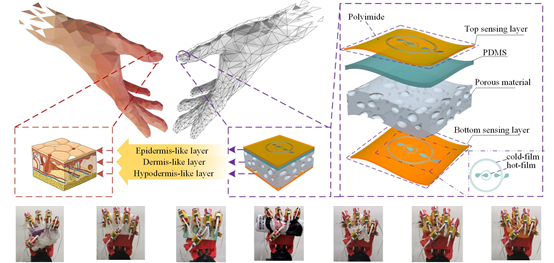
Figure: Multimodal tactile sensing for intelligent robotics.
Related research paper:
Guozhen Li, Shiqiang Liu, Liangqi Wang, Rong Zhu*. Skin-inspired quadruple tactile sensors integrated on a robot hand enable object recognition. Science Robotics, 5, eabc8134 (2020).
DOI: 10.1126/scirobotics.abc8134Full text: Original article link