
 Home
 Teacher login




MaterialsViewsChina features the research team's wearable pulse sensor using silver-particle-reinforced PDMS
The development of cardiovascular disease is often accompanied by long-term changes in the cardiovascular system. Early monitoring and diagnosis can effectively reduce its incidence and mortality. Pulse examination is an important component of the four diagnostic methods in traditional Chinese medicine: inspection, listening and smelling, inquiry, and palpation. By palpating the pulse at the cun, guan and chi positions on both wrists, physicians can assess the health of internal organs. Measuring pulse waveforms provides important physiological information about vascular elasticity, myocardial contractility and peripheral resistance, supporting the diagnosis and prevention of cardiovascular diseases such as arteriosclerosis and coronary heart disease. However, existing pulse measurement equipment is bulky and complex to operate, and wearable pulse sensors suitable for home monitoring remain scarce. Pulse measurements also require an applied preload, corresponding to the superficial (fu), medium (zhong) and deep (chen) levels used in traditional Chinese pulse examination. Sensors must therefore maintain high sensitivity and good linearity under preload to capture accurate pulse waveforms and characteristic parameters.
Recently, Professor Rong Zhu's research group in the Department of Precision Instrument at Tsinghua University developed a pulse pressure sensor based on thermosensation. Using a series configuration of silver-particle-reinforced polydimethylsiloxane (PDMS), the team created a functional composite that exhibits piezo-thermic transduction and offers tunable performance. By tailoring the material composition and structural parameters, the team developed a wearable pulse sensor that combines high sensitivity with good linearity under preload. In addition to recording pulse pressure waveforms, the sensor provides temperature self-compensation for pressure measurements and can measure skin temperature. Combining multiple sensors also enables pulse monitoring at several positions, including cun, guan and chi. The team measured radial arterial pulse waveforms in participants of different ages under different preloads corresponding to the superficial, medium and deep levels. Analysis of arterial stiffness indicators in these measurements demonstrated the feasibility of using the sensor to aid cardiovascular disease diagnosis.
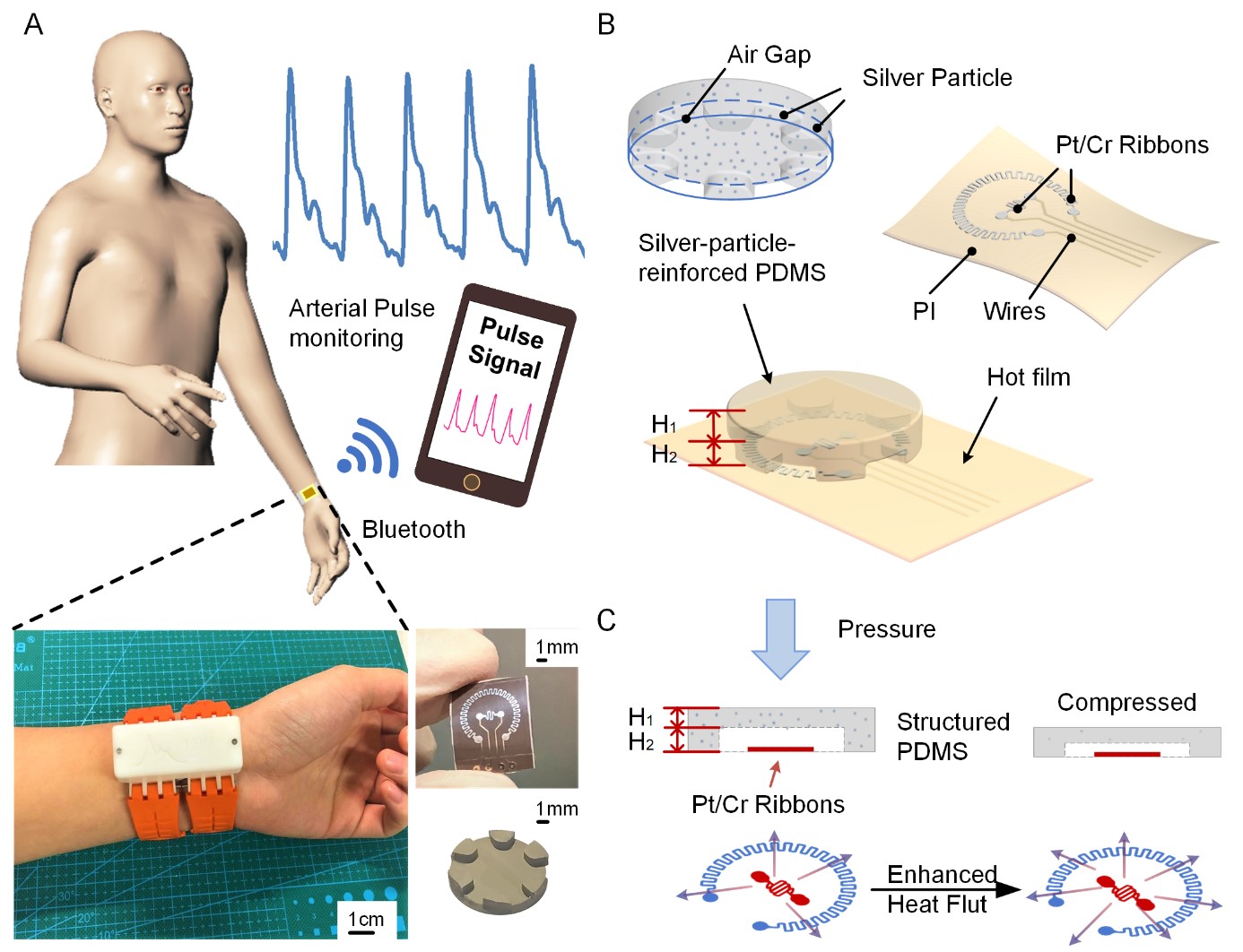
The researchers believe this work offers a practical solution for home health monitoring, wearable pulse monitoring and assisted diagnosis of cardiovascular disease. By combining the principles of traditional Chinese pulse diagnosis with the quantitative analytical and measurement methods of Western medicine, wearable radial pulse diagnostic devices that are easy to use and deliver high performance hold considerable promise.
The findings were published in Advanced Healthcare Materials under the title "A Wearable Sensor Using Structured Silver-Particle Reinforced PDMS for Radial Arterial Pulse Wave Monitoring" (DOI: 10.1002/adhm.201900633). The paper’s first author is Yu Fu, a master's student at Tsinghua University, and its corresponding author is Professor Rong Zhu of Tsinghua University.
MaterialsViewsChina report (in Chinese)