Home
 Teacher login




China's first miniature ultrafine aerosol sensor passes acceptance review
A project undertaken by Professor Rong Zhu's research team under the national program for the development of major scientific instruments recently passed an acceptance review by the Ministry of Education. Entitled "Development of a Contamination Monitoring and Control System Using Multisensor Information Fusion for Automated Nucleic Acid Testing Equipment", the project focuses on contamination monitoring and control.
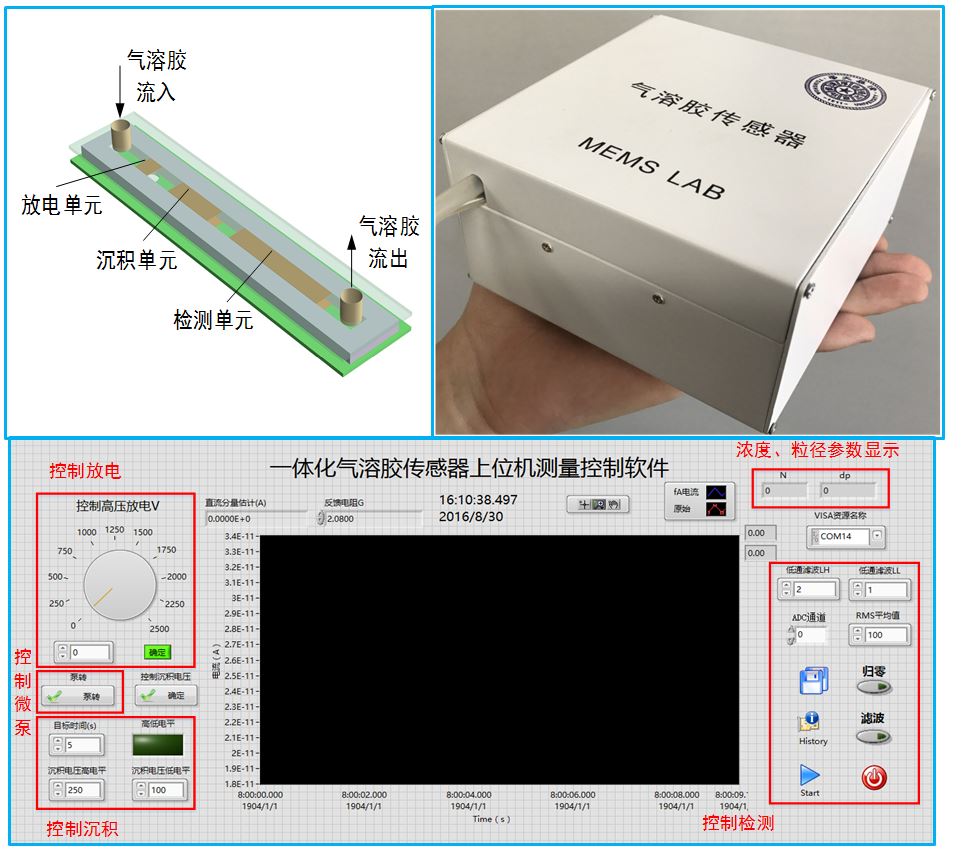
Ultrafine aerosol particles, with diameters on the nanometer scale, have serious implications for human health and the climate. They pose greater health risks than micrometer-sized PM2.5 particles because their small size makes them highly likely to deposit in the lungs and even enter the bloodstream. The team independently developed a miniature aerosol sensor based on its own intellectual property. Using diffusion charging, the sensor chip and associated measurement and control system integrate discharge, deposition and detection, enabling online measurement of nanoscale aerosol particle number concentration, particle size and size–concentration distributions. Applications include monitoring bioaerosols, such as those containing nucleic acids, and monitoring the atmospheric environment. This is China's first independently developed ultrafine aerosol sensor.