Home
 Teacher login




New multifunctional flexible electronic skin featured on the cover of Advanced Materials
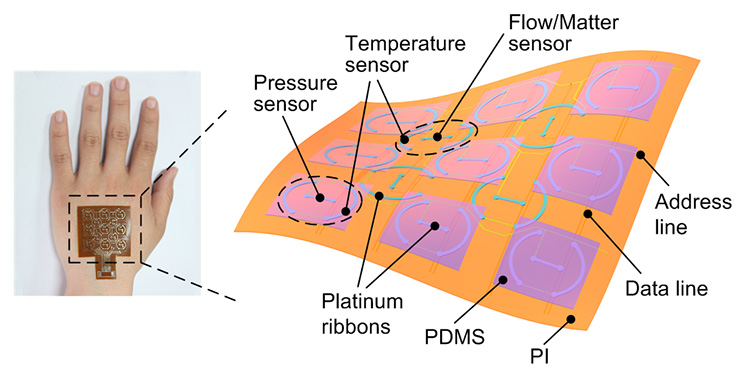
Professor Rong Zhu's research team at Tsinghua University recently published a cover article in Advanced Materials reporting the development of multifunctional flexible electronic skin. The team introduced the first thermosensation-based multiparameter sensing mechanism, enabling the high-density integration of touch, temperature, airflow and contacting-material sensing in a flexible electronic skin.
Flexible electronic skin is a major frontier of research, with broad prospects for applications in healthcare, intelligent robotics and other fields. Human skin is a remarkably sophisticated sensing system: it detects multiple external stimuli and relays information to the nervous system, eliciting physiological responses that enable interaction with the environment. In recent years, advances in flexible electronics and biomimetics have led to the development of ultrasensitive flexible pressure and temperature sensors based on different operating principles, mimicking the skin's ability to perceive mechanical and thermal stimuli. Human skin also has subtler sensing capabilities. It can detect airflow and distinguish the sensations of warmth and cold produced by contact with materials such as metal and wood, enriching human perception and emotional experience. Yet existing flexible electronic skins offer only limited integration of sensing functions. Achieving low-cost, large-area fabrication and high-density integration through simple processes also remains a major challenge to their practical use.
The team pioneered a mechanical-to-thermal conversion mechanism based on a porous elastic medium for sensing pressure and stress. A porous elastic membrane converts external pressure into changes in heat conduction, allowing pressure, temperature, airflow and material properties to be represented as thermal effects and detected by thin-film thermistors. This approach offers a simple sensing structure, high sensitivity, rapid response and low hysteresis. Its measurement range and sensitivity can be readily adjusted through electrical heating control, and the sensors can be fabricated on flexible substrates. Because the sensing structure and detection principle are shared across pressure, temperature, airflow and contacting-material sensing, arrays for pressure, temperature and flow/material sensing can be integrated on a single flexible substrate. The resulting electronic skin combines touch, temperature, airflow and contacting-material sensing to emulate the multimodal sensory capabilities of human skin, while offering low cost, a high degree of integration and ease of fabrication over large areas.
This thermosensation-based multiparameter sensing mechanism allows electronic skin to incorporate multiple sensing functions without increasing system complexity, offering a new approach to expanding its functionality and achieving high-density integration. The electronic skin can be combined with flexible printed circuits to facilitate low-cost manufacturing over large areas, with wide-ranging potential applications in healthcare and intelligent robotics. The findings were published in Advanced Materials (DOI: 10.1002/adma.201606151). The paper's first author is Shuai Zhao, a doctoral student in the Department of Precision Instrument at Tsinghua University, and its corresponding author is Professor Rong Zhu of the same department.
Paper link: 10.1002/adma.201606151