Home
 Teacher login




Advances in cell-integrated chips: A breakthrough in the in situ dynamic measurement of single-cell traction forces
Under the national program for the development of major scientific instruments and equipment, the research team undertook the project "High-Throughput Cell Sorting, Multimodal Analytical Instrumentation and Applications". Through its investigation of single-cell force measurement methods, the team achieved a breakthrough in the key technology for monitoring single-cell traction forces dynamically and in situ.
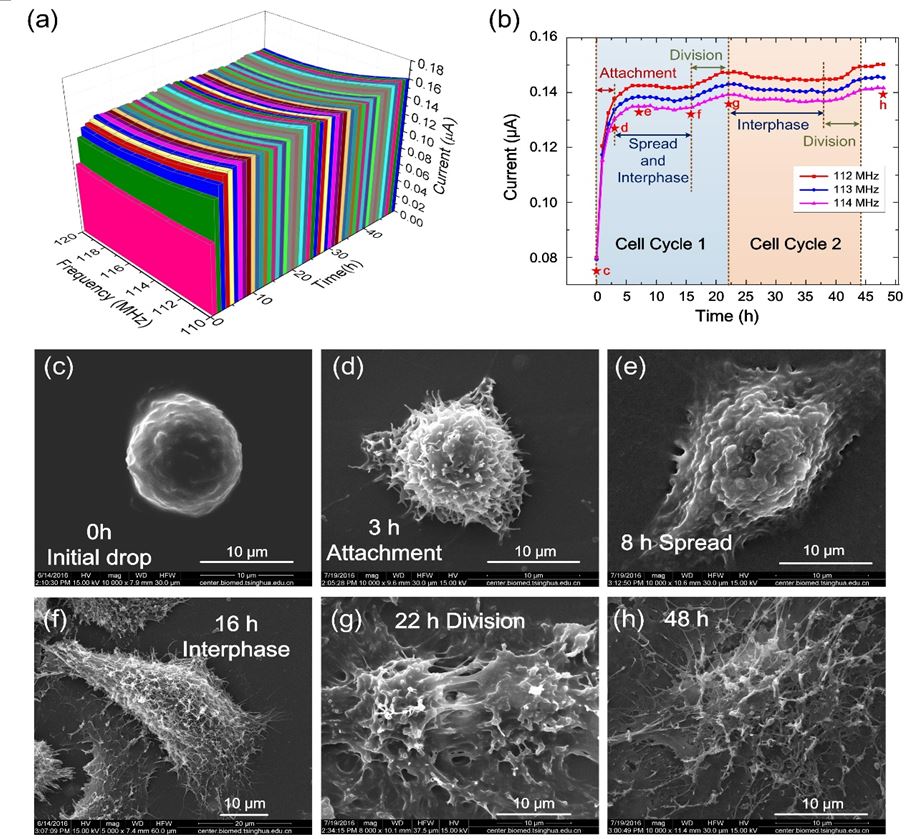
Monitoring cell traction forces is an important aspect of cell research, helping reveal how mechanical factors influence cell growth, development, maturation, proliferation, aging and death. Building on earlier breakthroughs in multimodal detection techniques, including in situ single-cell electrical impedance spectroscopy (EIS) and in situ surface-enhanced Raman spectroscopy (SERS), the group investigated methods for measuring cell traction forces in situ. The team proposed a nanoscale field-effect transistor sensing technique that uses semiconductor nanowires as force-sensitive elements, enabling in situ dynamic monitoring of single-cell traction forces and long-term tracking of cellular processes. This label-free force measurement method offers ultrahigh sensitivity with a resolution of 5 nN. High-frequency lock-in detection and biocompatible encapsulation minimize disturbance to the cells, making the technique suitable for long-term monitoring of living cells. The figure shows results from 48 hours of HeLa cell monitoring spanning two cell cycles. The measurement trace in panel (b) clearly distinguishes characteristic stages, including attachment, spreading, interphase and mitosis, consistent with cell morphology recorded at corresponding stages using a freezing method. The technique enables quantitative, in situ analysis of cellular forces. By tracking these forces, researchers can quantify changes in traction throughout cellular processes: for example, traction forces were found to change by approximately 120–150 nN during attachment and approximately 15 nN during interphase and mitosis. This provides an effective tool for further investigation of cellular biomechanical mechanisms.
The findings were published in Scientific Reports, 7, 43661 (2017). DOI: 10.1038/srep43661.
Paper link: Scientific Reports article